
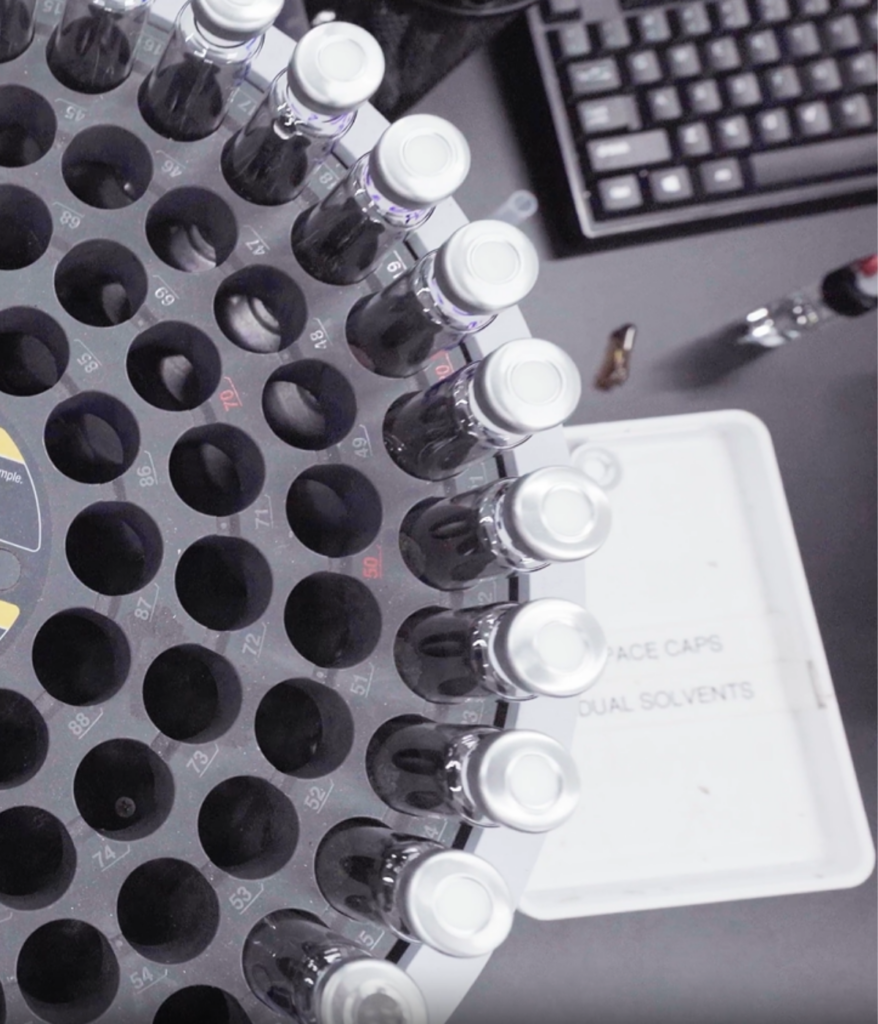
Optiq Health Labs provides independent residual solvent testing for peptides using advanced GC-MS technology. Our laboratory detects trace manufacturing solvents that may remain after synthesis and purification to help support product quality, manufacturing consistency, and confidence in peptide testing results.
At Optiq Health Labs, we use advanced GC-MS (Gas Chromatography–Mass Spectrometry) technology to identify and quantify residual solvents with exceptional sensitivity. By screening for these manufacturing residues, residual solvent testing provides a critical layer of quality assurance and helps ensure that products have been properly purified before reaching the end user.
A peptide can be correctly identified, highly pure, and accurately dosed, but residual solvent testing helps verify that unwanted manufacturing chemicals have not been left behind.
While our solvent panel is expanding, here are some of the solvents we test for:
• Acetonitrile
• Methanol
• DMF
• DCM
• THF
• Pyridine
• Ethanol
• IPA
• Acetone
• Ethyl Acetate
• Hexane
• Toluene
Residual solvents are chemicals used during peptide manufacturing that can remain in the final product if purification is incomplete. While often present only in trace amounts, some solvents can pose health risks when introduced directly into the body through injection.
Depending on the type and concentration, residual solvents may contribute to injection-site irritation, inflammation, headaches, nausea, and other adverse reactions. Certain solvents have also been associated with liver, kidney, neurological, or other toxic effects when exposure exceeds established safety limits. Because these compounds are not detected through standard identity or purity testing, specialized analysis is required to determine whether they are present.
How much does LC-MS peptide purity testing cost and how long does it take?
Purity testing is one of the most important analytical procedures used in peptide quality assessment. Even when a product is labeled as a specific peptide, manufacturing processes, handling conditions, storage environments, and degradation over time can introduce additional compounds that are not part of the intended material.
At Optiq Health Labs, we use advanced Liquid Chromatography–Mass Spectrometry (LC-MS) methods to evaluate peptide purity with a high level of precision and consistency. LC-MS technology separates the individual components within a sample while simultaneously confirming molecular identity through mass analysis.
This process allows our laboratory to:
Liquid Chromatography (LC) separates the individual compounds within a sample. Mass Spectrometry (MS) then identifies and analyzes those compounds by measuring their molecular mass and structure.
We utilize Liquid Chromatography–Mass Spectrometry to separate compounds within the sample and identify the molecular mass of detectable components.
Testing helps determine the relative percentage of the intended peptide compared to other detectable substances present in the sample.
Mass spectrometry helps verify that the detected primary compound aligns with the expected molecular profile of the target peptide.
Analysis may reveal manufacturing impurities, degradation compounds, residual byproducts, or other detectable materials within the sample.
Optiq Health Labs provides peptide purity testing services for researchers and organizations throughout the United States. Samples can be submitted securely for laboratory analysis and reporting. Whether you are looking for independent peptide purity testing, LC-MS analysis, or third-party verification services, our laboratory is available to help support your analytical testing needs.
Overnight FedEx/UPS from all 50 states to our lab in California.
Standard turnaround with rush 2–3 day option available.
Comprehensive Certificate of Analysis delivered electronically.
Residual solvents are chemicals used during peptide synthesis and manufacturing that may remain in the final product if purification is incomplete.
Yes. A peptide may show high purity during chromatographic testing while still containing trace solvent residues that require specialized GC-MS analysis to detect.
Certain solvents may contribute to irritation, inflammation, or toxic effects when exposure exceeds recommended safety limits.
Optiq Health Labs uses Gas Chromatography–Mass Spectrometry (GC-MS) to identify and quantify residual solvents within peptide samples.
For bacteriostatic water, our testing can be used to detect and quantify benzyl alcohol, the preservative expected in the formulation.
This helps verify that benzyl alcohol is present and that its measured concentration is consistent with the product's stated formulation.
Access the Optiq Health Labs Customer Portal to submit samples, manage testing, and stay connected with our laboratory team.

Independent Peptide Testing You Can Trust
We use cookies to improve your experience on our site. By using our site, you consent to cookies.
Manage your cookie preferences below:
Essential cookies enable basic functions and are necessary for the proper function of the website.
These cookies are used for managing login functionality on this website.
Statistics cookies collect information anonymously. This information helps us understand how visitors use our website.
GoDaddy's visitor traffic tracking, added automatically to sites hosted with GoDaddy and to sites built with GoDaddy Website Builder. It records page views, clicks, and page timing, and sends them to GoDaddy to measure traffic and site performance.
Service URL: www.godaddy.com (opens in a new window)
Google Analytics is a powerful tool that tracks and analyzes website traffic for informed marketing decisions.
Service URL: policies.google.com (opens in a new window)
You can find more information in our Cookie Policy and Privacy Policy.